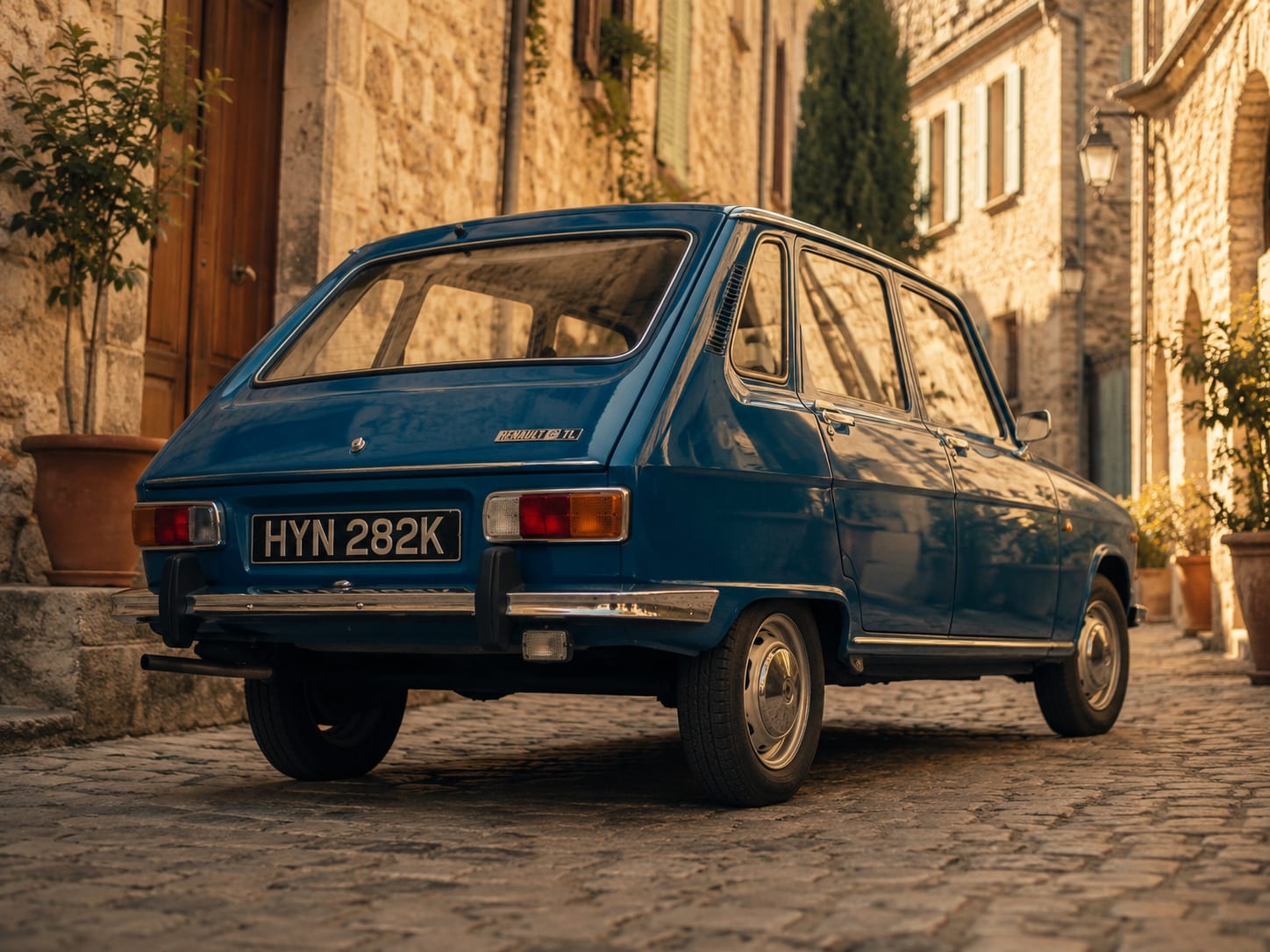
The Renault 6 was never a car you looked at twice. That’s precisely what makes it forgotten - and precisely what makes it interesting today.
A hatchback compact for families, launched at the Paris Motor Show in 1968, produced until 1980 in France (and longer elsewhere). You used to see it everywhere in the 70s without noticing it. Today, finding a sound one is hard, and collectors are starting to wake up.
In short
- The R6 anticipates the recipe Renault would later brand “la voiture à vivre” (the car for living) from 1985 onward: hatchback, modularity, versatility
- Production: 1968-1980 (France), until 1986 in Spain and Argentina
- Mechanicals: front-wheel drive, platform derived from the Renault 4, Billancourt 845 cc and Cléon-Fonte 956/1108 cc engines
- Weak point number one: rust (fenders, windshield corners, wheel arches, hatch)
- Celebrity owners: Valéry Giscard d’Estaing was using one in Chamalières in April 1974, and Louis de Funès owned two, which he preferred to his Jaguar Mark 2
History: between the 4L and the R16
The Renault 6 was unveiled at the Paris Motor Show in October 1968. On paper it slots between the 4L and the 16, hence the nickname “mini R16”. In reality, its commercial positioning is more specific: it’s a 4L moved upmarket, designed to take on the Citroën Ami 6 and Dyane in the family compact segment.
Two styling tweaks punctuate its career:
- June 1973: notable restyling. Square headlights, plastic grille, new bumpers, turn signals integrated into the front bumper. This is the silhouette most people associate with the R6.
- 1978: light facelift, black grille.
Production stopped in France in 1980, but continued abroad: Spain and Argentina until 1986. In total, about 1.7 million units (1,743,314 according to Wikipedia).
The R6 has that in-between car status: neither the absolute popular icon (the 4L), nor the status family car (the R16). People saw a lot of them, but rarely talked about them.
Design and packaging: the hatchback does everything
Aesthetically, the R6 doesn’t leave a lasting impression. Simple silhouette, sober lines, often judged plain. What it offers happens inside.
From its earliest years, the R6 offered a genuine practical compact concept:
- rear hatch
- foldable and removable rear bench
- gear lever on the dashboard (inherited from the Renault 4)
In 2026, that sounds mundane. In 1968, it’s a pragmatic proposal that anticipates the 5-door compacts we know today, and that Renault would later theorize publicly with its “la voiture à vivre” campaign launched in 1985.
Under the hood: engines and performance
Architecture
Front-wheel drive with a longitudinal engine, a peculiarity shared with the Renault 4: the gearbox sits in front of the engine, front-overhung. This layout is what explains the gear lever that comes straight out of the dashboard, via a linkage that runs over the block. Many parts are shared with the 4L.
Engines
- 845 cc Billancourt: 34 hp on the base version, top speed around 120 km/h
- 956 cc Cléon-Fonte: powers the early TL and stays in Spain for tax reasons (taxation above 1040 cc)
- 1108 cc Cléon-Fonte: from 1971 onward, on the TL, with front disc brakes. 47 hp, top speed around 135 km/h
The R6 isn’t a performance car. Its interest lies in versatility and simplicity.
The intriguing technical detail: the asymmetric wheelbase
An engineering quirk that always surprises new owners.
The R6 inherits the Renault 4’s rear suspension architecture: two transverse torsion bars that can’t overlap, so one is offset toward the front and the other toward the rear. Result: the car has a different wheelbase on the left and right, by a few centimeters.
It’s intentional. This packaging choice keeps the platform simple, robust, and frees up maximum cabin space. The same quirk shows up on the Renault 4 and the 5.
Anecdotes: Giscard, Louis de Funès, cinema
Giscard’s R6
On April 8, 1974, on the morning of the presidential runoff he would go on to win, Valéry Giscard d’Estaing was photographed at the wheel of a Renault 6 between Chanonat and Chamalières, in the Puy-de-Dôme. The car was tied to his family estate at Varvasse, in Chanonat (Carjager, L’Argus).
What’s interesting isn’t the “glamour” angle (there isn’t one). It’s exactly that it fits the R6’s role: the simple, practical, almost invisible car. Until someone notices it.
Louis de Funès
The actor first bought a Jaguar Mark 2, then judged it too luxurious. He fell back on two white Renault 6 TLs: one for him, one for his wife. He lent the Jaguar to his son, but not the R6s (L’Argus, exhibition of his film cars). A choice consistent with a car without ostentation.
Cinema: Pile ou face (1980)
The R6 appears in Pile ou face (1980). The IMCDB database lists a 1979 Renault 6 TL “used extensively” by a main character.
2026 buying guide: what to check
Good news: it’s a simple car. Bad news: rust can ruin everything.
Rust checklist (top priority)
The points to check systematically, as listed by the enthusiasts at r4-4l.com:
- tips of the front fenders
- windshield corners
- fender mounting points
- roof / hatch (leaks)
- fuel filler flap
- wheel arches
Tip: prioritize a structurally sound car (floors, chassis rails), even if the upholstery is tired. The interior is easier to redo than the sheet metal.
Which version to pick?
- For cruising / “original” charm: an 845 cc version is enough to roll along quietly
- For road use / comfort: the TL with its 1108 cc is more versatile and more pleasant at 90-110 km/h
Parts
The technical base close to the 4L makes life easier for mechanical parts. On the other hand, some bodywork and interior parts are specific to the R6 and harder to find. The 4L-R6 Club de France can help with documents and parts.
Reference sheet
The numbers to have on hand before going to see a car, talking to a seller or ordering paint.
Spec table
| Spec | R6 / R6 L (845 cc) | R6 TL (1108 cc) |
|---|---|---|
| Engine | Billancourt 845 cc, 4-cylinder | Cléon-Fonte 1108 cc, 4-cylinder |
| Power | 34 hp | 47 hp (45 hp DIN depending on the source) |
| Torque | 58 N·m | 79 N·m |
| Top speed | approx. 120 km/h | approx. 135 km/h |
| Gearbox | 4-speed manual, dashboard-mounted lever | 4-speed manual, dashboard-mounted lever |
| Brakes | drums front / rear | front discs (from 1971), rear drums |
| Length / width / height | 3.85 m / 1.53 m / 1.48 m | same |
| Wheelbase | 2.40 m left / 2.45 m right | same |
| Kerb weight | approx. 700-750 kg | approx. 800-820 kg |
| French tax rating | 5 CV | 6 CV |
| Drivetrain | front-wheel drive, longitudinal engine, gearbox ahead of the engine | same |
Outside France: Spain kept a 956 cc unit (tax threshold above 1040 cc) then offered a 50 hp 1108 cc GTL in 1981; Argentina used a 51 hp 1118 cc engine, then a 60 hp 1397 cc on the 6 GTL from 1978. Sources: Wikipedia FR and Wikipedia EN.
Model-year timeline
| Year | Change |
|---|---|
| Oct. 1968 | Unveiled at the Paris Motor Show. R6 845 cc, 5 CV, drum brakes |
| 1970 (1971 model year) | R6 TL 1108 cc: front discs, lowered gear lever, larger fuel tank |
| 1972 | White front turn signals, side repeaters removed |
| 1973 | The 845 gets the TL gearbox. Launch of the Rodéo 6 (Teilhol / ACL) |
| June 1973 (1974 model year) | Restyling: square headlights, plastic grille, new bumpers with integrated turn signals |
| 1976 | The base version becomes the R6 L |
| 1978 | Black grille. In Argentina, the car is renamed 6 GTL |
| June 1979 | End of the 845 cc in France |
| May 1980 | End of production in France |
| 1984 | End of production in Argentina (80,872 units) and Colombia (approx. 42,500 units) |
| March 1986 | End of production in Spain (327,802 units). Worldwide total: 1,743,314 units |
Factory colours
The R6 catalogue lists 47 colours between 1969 and 1980, documented by 50 nuances de teintes Renault. A few landmarks:
- Whites: 322 (1969-1970), 355 (1971-1975), 319 (1976-1980). White is by far the most common colour, the one on Louis de Funès’s two TLs
- Noir 699 (black): 1969-1974
- Typical 70s yellows / oranges: Jaune 388 (1969), Orange 311 (1974-1975), Jaune Citron 301 (1974-1975), Jaune Tournesol 308 (1976-1979)
- Blues: Bleu Moyen 439 (1970), Bleu Clair 456 (1972-1973), Bleu Touareg 464 (1978-1979), Ardoise 422 (1978-1980)
- Greens: Vert Foncé 942 (1969-1971), Vert Jardin 907 (1976-1977)
- The five rarest: Gold 391, Bleu Gris Métal 435, Bleu RAF Métal 442, Prune Métal 708, Vert Bornéo 906
For an “original” restoration, start from the manufacturer’s plate (paint code) rather than the visible colour: many R6s have been resprayed.
Collector price ranges (2026)
The French LVA price guide is no longer freely available online. The ranges below are orders of magnitude taken from French and European listings (lesAnciennes, Leboncoin, Le Parking, Dyler) in summer 2026, on a private-sale market where prices move fast.
| Condition | Indicative range |
|---|---|
| Project / needs restoration, running or not | €1,000 - €2,500 |
| Running, fair condition, roadworthy | €2,500 - €4,500 |
| Very good condition or properly restored | €4,500 - €7,000 |
| Exceptional (low mileage, original, rare colour) | €7,000 - €9,000, rarely more |
Two nuances. The TL 1108 is more sought after for driving, but a sound, original “phase 1” 845 trades at the same level or higher, because it has become rarer. And rust matters more than mileage: a car with 130,000 km and solid floors is worth more than one with 60,000 km and wheel arches to redo.
Why it’s coming back into fashion
The R6 is shifting from “ordinary car” to “object car” because it’s becoming rare, and because its qualities (practicality, simplicity) are exactly what we’re rediscovering today.
On top of that, an entry into the collector market that’s still accessible compared to other 60s-70s icons, and an “anti-bling” charm that stands out in an era of SUVs and giant screens.
Plenty to make it a Sunday drive companion, or a restoration project that doesn’t bankrupt its owner.
FAQ
Is the Renault 6 a real modern compact?
In spirit, yes: hatchback and modular bench seat, it’s the direct ancestor of today’s 5-door compacts. Technically, it sits between the Renault 4 and the Renault 16, with a base close to the 4L.
Until when was it produced?
France until 1980. Spain and Argentina until 1986.
What’s the number 1 weak point?
Rust. To check before any aesthetic consideration.
Why do people talk about an asymmetric wheelbase?
It’s an effect of the rear torsion bar packaging on this platform, inherited from the Renault 4. The R6 therefore has a slightly different wheelbase on the left and right, by a few centimeters.
Did the R6 really “invent the car for living”?
No. The slogan “la voiture à vivre” was launched by Renault and its agency Publicis in 1985, in the context of the Espace. The R6 does however anticipate the practical and modular spirit that this campaign would later highlight.